Chelonus antennalis
author(Thomson 1874)
synonyms
body
shape♀ length 3.7mm [P2], 4-5mm [T4], ,4 mill.(?)[Th], 3.3 - 3.5mm [WA]. 3.5mm [Ch]. 3.0 - 4.0 mm [Te1].
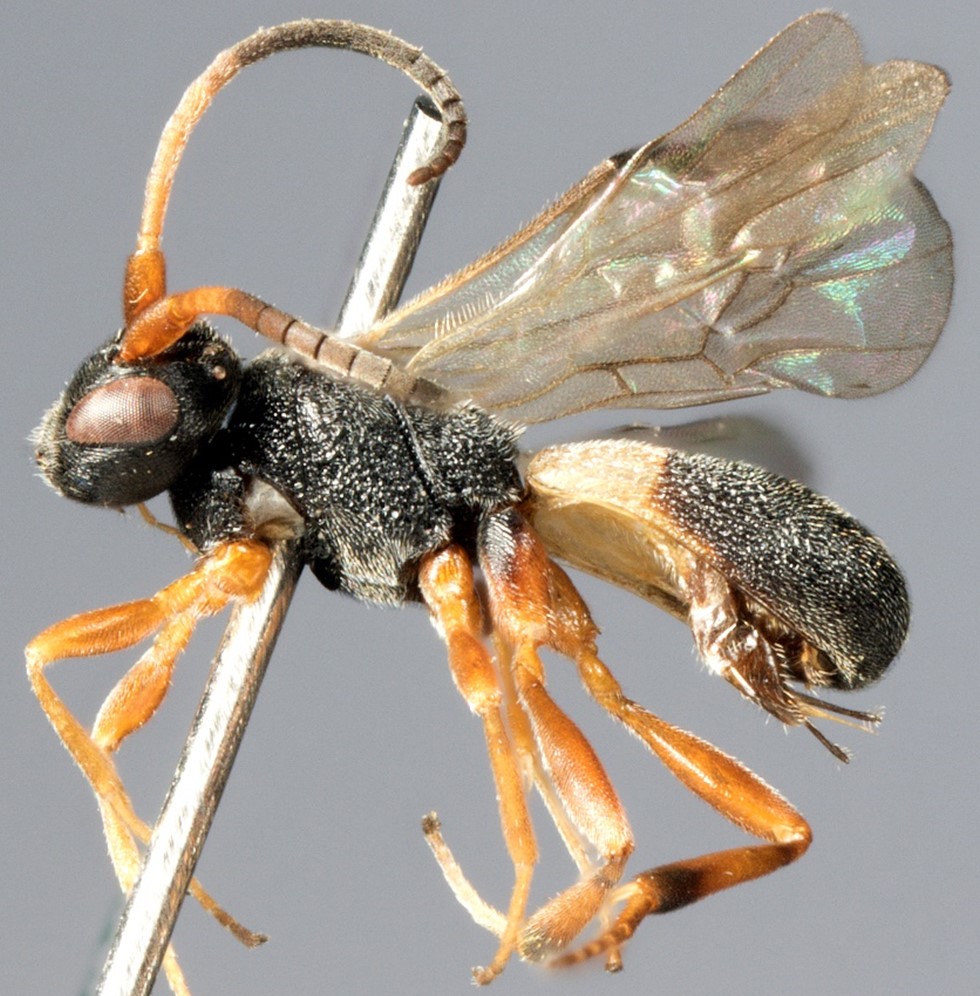
colorGround colour of body black [Th][P2].
head
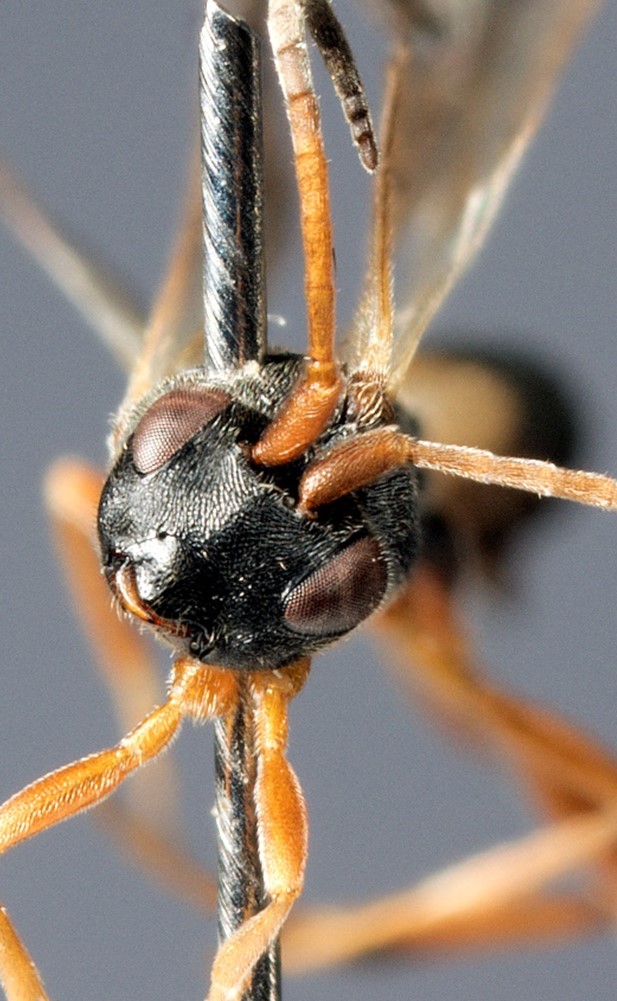
shapeHead in dorsal view (Fig. 1) 2x as broad as long, eye somewhat longer than temple, latter receded. Ocelli medium-sized and round, distance between fore and hind ocelli as long as diameter of an ocellus, POL: OD: OOL as 10: 5: 15. Eye in lateral view 2.3x as high as wide, temple almost 1/3 wider than eye (Fig. 2). Malar space 0.25 longer than basal width of mandible. Face 1.42x as wide as high, inner margin of eyes subparallel, i.e., indistinctly converging ventrally. Clypeus less wide than face, 1.58x as wide as high, distance between tentorial pits about 0.25x longer than that between pit and lowest point of eye [P2]. The head is 1.9 times as wide as long, and 1.2 times as wide as mesosoma. The ocellus is medium in size, OOL: OD: POL = 1.2: 0.4: 0.9. Eye in dorsal view 1.8 times as long as temple. The width of the face is 1.4 times the height. Clypeus as high as face, separated from the face by a thin horizontal line.. Clypeus width 1.6 times the height, 0.6 times the width of the face. The malar space is 1.2 times the mandible base width [Ch]. The head is transverse, strongly roundly narrowed posteriorly. Malar space equal to 1/2 of the longitudinal diameter of the eye; the temples are much larger than the width of the eye. Small ocelli; the distance between them and the eyes is 3–4 times the diameter of the ocellus [Te1].
sculptureFace with fine and semicircular striation, cheek densely rugulose, clypeus shiny with very fine punctation. Vertex and temple also with fine striation (Fig. 1) [P2]. Clypeus shiny, with tiny granular punctures. The temples have dense, thin horizontal rugae and small punctures [Ch]. Head entirely rugulose, dull. The frontal fovea are smooth, shiny [Te1].
colorPalpi brownish yellow [P2].
antenna
shape ♀♀: antenna somewhat curved with 18 segments [Th]. About as long as head + mesosoma + 0.5 carapace. 3rd segment 3x as long as apically broad, further segments gradually shortened so that penultimate segment is 1.4x as long as apically broad [P2]. The antenna is shorter than the body, the middle part not widened, the last segment is close to cylindrical, the apex slightly pointed. The length of the scapus, 3rd , 4th and penultimate segments are respectively 3.0, 4.0, 2.6 and 1.4 times the width [Ch]. Antennae equal to 2/3 body length, thick, filiform, slightly thinning towards the apex, 18-membered; the scapus is ovoid [Te1].
shape ♂
colorAntennae in basal part brownish yellow [Th][T4]. Scape black, pedicel and segments 3-4 brownish yellow, further segments darkening blackish [P2]. Scape variable, pedicel and segments 3-6 brownish yellow (see photo's) [WA]. Dark red-brown scapus, brown flagellum [Ch].
mesosoma
shapeMesosoma in lateral view 1.42x as long as high. Notauli distinct, somewhat crenulated. Propodeum with a pair of small latero-median tubercules [P2]. Propodeum posteriorly truncate, with a distinct transverse carina, weak middle teeth and large lateral teeth [Ch]. Propodeum with a transverse ridge in the middle, with short teeth on the sides [Te1].
sculptureMesosoma (areolate-) rugose, mesonotum and scutellum somewhat rugulose and shiny [P2]. Mesosoma reticulate. The scutellar sulcus has 6 pits. The center of the scutellum is raised, smooth and shiny, with reticulated wrinkles at the edges. The mesopleurae are shiny, with small reticulated wrinkles, and small shallow depressions. The propodeum is reticular rugose [Ch]. Mesonotum and sides of mesosoma roughly wrinkled. Notauli are absent. Scutellum rugose, matte. The propodeum is coarsely reticulate-rugose [Te1].
color
legs
shapeHind femur 4x as long as medially broad; pair of spurs of hind tibia of nearly same length, inner (or longer) spur shorter than 0.5 basitarsus (♂. Fig. 7). Hind tibia and tarsus equal in length, hind basitarsus as long as tarsomeres 2-4 [P2]. The length of the hind femur, tibia and metatars are 3.5, 5.0, and 6.0 times the width respectively; the ratio of the length of the hind tarsal segments is 3.6: 1.6: 1.1: 0.9: 0.8; The inner spur of the hind tibia is half as long as the metatars; the tarsal claws are small and the middle process is not distinct [Ch]. The hind legs are noticeably thickened [Te1].
sculptureHind coxae with dense, fine horizontal stripes [Ch].
colorGreater part of legs black [T4]. Legs brownish yellow, coxae brown, femora 2-3 and distal 1/3 of hind tibia brownish [P2]. Fore and midleg (except for the reddish-brown end tarsus) brownish yellow, base of hind metatars, half of femur and both ends of tibia reddish brown, the rest is reddish-yellow brown [Ch]. Legs are red; hind coxae for the most part, apex of hind femora, base and apex of hind tibiae black [Te1].
wings
shapeFore wing shorter than body. Pterostigma (Fig. 3) distinctly 3x as long as wide, issuing radial vein distally from its middle, R1 as long as length of pterostigma; 1-R1 about 1/6 shorter than pterostigma, 3-SR 1/3 longer than r1, SR1 almost straight and ending far before tip of wing [P2]. : The length of the pterostigma is 3.0 times the width; 1-R1 as long as the pterostigma; vein r extends distally from the middle of the pterostigma, r: 2-SR: 3-SR: SR1 = 1.1 : 2. 9: 1.2: 5.0, vein r and SR1 are slightly curved; 1-CU1: 2-CU1 = 1.2: 3.0; hindwing M + CU: 1-M = 4.0 : 3.2. Fore wing length 2.7mm [Ch]. Vein r slightly longer than 3-SR, SR1 straight, 4 times as long as r. 1-R1 as long as pterostigma. r-m equal to 3-SR. 1-CU1 = 0.33 times 2-CU1 [Te1].
colorWings somewhat transparent, pterostigma and veins opaque brownish yellowish [P2]. Tegula brownish [P2]. Tegulae brown, wing light smoky brown, pterostigma brown, wing veins light brown [Ch]. The wings are light; pterostigma and tegulae are brown [Te1].
metasoma
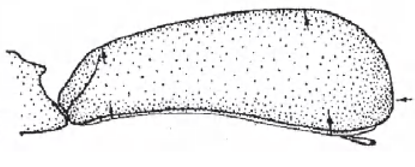
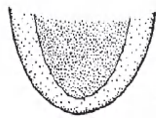
shapeCarapace in dorsal view (Fig. 4) 1.8x as long as medially broad, in lateral view (Fig. 5) 2.6x as long as high posteriorly; in ventral view (Fig. 6) slightly incurved, i. e., ventral cavity almost as long as carapace itself [P2]. Metasoma is oval in dorsal view, 1.8 times as long as wide, with a blunt end. In lateral view, the end is gradually inclined, and the ventral cavity is almost as long as the carapace [Ch]. Metasoma slightly longer than mesosoma, oval [Te1].
sculptureCarapace with rugosity (Fig. 4), posteriorly this sculpture (on declivous part of carapace) weakens to rugulosity [P2]. Metasoma for 1/4 of the base with large longitudinal reticular rugae, the rest with small reticular rugae to irregular rugulose punctate [Ch]. Metasoma, except for apex, with sharp longitudinal rugae [Te1].
color1st metasomal segment completely pale yellow [Th], Basal 1/3 of carapace lemon yellow [P2]. The base 1/3 of the carapace is almost transparent yellow-white [Ch].
♀ ovipositorOvipositor sheath very short, concealed [P2]. The ovipositor sheath is projecting beyond the end of the carapace, and is 1.3 times longer than the hind metatars [Ch]. The ovipositor is short and straight [Te1].
♂ aperturemale unknown [P2]
other info
distributionDE,SE [FE]. NL [WA]
remarksseems to be related to seticornis and jacobsoni in regards of body size (3.7-4 mm), fine striation of occiput + temple and the form of carapace [P2]. Similar to fenestratus with respect to punctation, shape and size [Th]. Close to Ch. gravenhorsti Nees, from which it is easily distinguished by its thick antennae and body coloration [Te1].
hosts