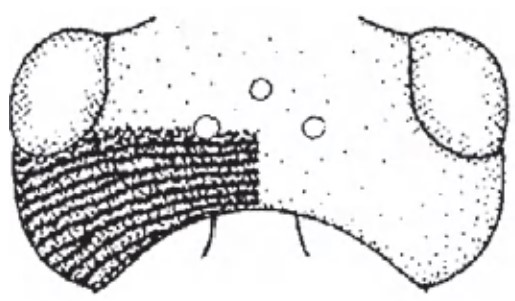
shapeHead in dorsal view (Fig. 1) transverse, 1.9 - 2.0x as broad as long, temple rounded, slightly longer than eye [P2]. Ocelli small and round, POL: OD: OOL as 14:4: 14, i.e. POL = OOL. Eye in lateral view 1,7x as high as wide, eye and temple equal in width. Malar space somewhat longer than basal width of mandible. Inner margin of eyes parallel [P2].
shape ♀♀: Antenna with 27 (1♀) segments [P2]. Antenna with 24-27 segments (♂♀), penultimate 3-4 segments cubic or subcubic [P1]. Female flagellum not filiform, i.e. medially more or less flattened [P1].
shape ♂Antenna with 24-27 segments. Penultimate 3-4 segments 1.2-1.3 times as long as broad [P1]. ♂ 26 segments, penultimate segments quadratic [H2].
colorAntenna black [P2].
mesosoma
shapeIn lateral view 1.5x as long as high. Notauli distinct with somewhat roughened sculpture. Propodeum with a strong transverse carina ending laterally in a pair of tubercules [P2].
sculptureMesosoma rugose with more or less areolate elements [P2]. Largely mat, striated or rugose scutellum [H2][P2]. Scutellum matt, somewhat rugose [M2].
color
legs
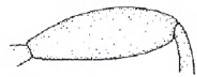
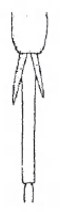
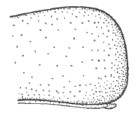
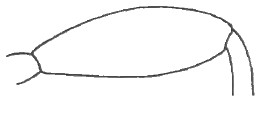
shapeHind femur 2.8 - 3.2x as long as medially broad (Fig. 42). Pair of spurs of hind tibia subequal in length, inner (or longer) spur somewhat shorter than 0.5 basitarsus (Fig. 43). Hind tarsus somewhat longer than hind tibia, hind basitarsus as long as tarsomeres 2-4 [P2].
sculpture
colorFore femora reddish, hind tibiae with red base and apex [F2]. Legs dark coloured, hind femur black (at most apically brownish to yellowish) [P1]. Coxae, trochanters and femora 2-3 blackish brown; fore femur, tibia and tarsus yellow, fore femur basally dark brownish, tibiae 2-3 apically and tarsi 1-3 fully dark brownish [P2].
wings
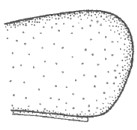
shapeFore wing shorter than body. Pterostigma (Fig. 44) 2.6 - 3.0x as long as wide, issuing radial vein from its middle, metacarp as long as pterostigma. 1-R1 shorter than pterostigma (see arrows in Fig. 44, 69), r somewhat shorter than 3-SR, SR1 straight and ending far before tip of wing [P2]. r usually clearly shorter than 3-SR [P1].
colorWings brownish fumous, pterostigma brown and veins distally opaque brown, proximally opaque yellowish [P2]. Tegula blackish brown [P2].
metasoma
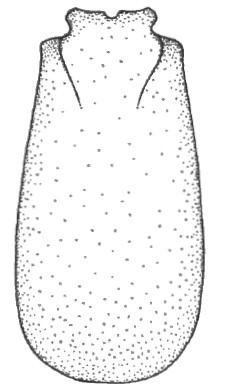
shapeCarapace in dorsal view (Fig. 45) 1.9 - 2.1x as long as broad posterior of its middle, apically less rounded [P2].Twice (♀) to 2-2.2 times (♂) as long as broad posteriorly (Fig. 65, 66) [P1]. In lateral view (Fig. 46) 2.45x as long as posterior height, its posterior end trunctate (see arrow in Fig. 46, . 65, 66) [P1][P2]. In ventral view just incurved (Fig. 47), i.e., ventral cavity almost as long as carapace itself [P2].
sculptureCarapace anteriorly with longitudinal strio-rugosity, posteriorly rugose (Fig. 45) [P2]. Metasoma striated for more than half [H2].
colorWithout spots [F2]. ♂ completely black [H2]. ♀♂ Carapace always entirely black [P1].
11. C. humilis n. sp: Niger, genubus tibiisque auterioribus, posticis medio testaceis, genis buccatis subrugosostriatis, postscutelli carina humili, baud dentato-elevata. Long 7—8 mill.
Praecedenti colore et antennarum structura simillimus, sed paullo minor, genis minus buccatis, mesonoto prope parapsidas fortiter punctato, scutello disco subopaco, convexiusculo, subrugoso, abdomine oblongo postscutellique carina media parum elevata, baud dentato-fastigiata, praestigmate et nervis costalibus paullo obscurioribus optime distinguendus.
Sällsynt i Skåne.
Data used in the multi-access key
These data are collected from the species descriptions and redescriptions, from published figures and photographs and from own measureements and observations. For a description of the different variables and value classes see this pdf.
morphology
basic information
female
male
body length (mm):
(4.6) 4.6 - 6 (6.4)
(4.6) 4.6 - 6 (6.4)
number of antennal segments:
(23) 23 - 26 (27)
(24) 24 - 27 (28)
head, dorsal view
Head width : length
narrow, wide
narrow, wide
Temples narrowing - widening
parallel
parallel
Eye length : temple length
0.75 - 1.0
0.75 - 1.0
Roundness temple
strong, medium
strong, medium
POL : OD
3 - 4
3 - 4
Ocellar triangle shape
wide
wide
Excavation of head
15 - 25%, 25 - 35%
15 - 25%, 25 - 35%
head, lateral view
Head height : length
---
---
Eye height : length
very short
very short
Temple length : eye length
very short, short
very short, short
head, frontal view
Head width : height
---
---
Face width : height
---
---
Eyes converging ventrally
about parallel
about parallel
EH : MSL
---
---
Clypeus width : height
---
---
Clypeus extending above bottom of eyes
---
---
Tentorial pits
---
---
Shape of lower margin clypeus
---
---
antennae
Antennal shape
slightly widened, clearly widened
filiform, not widened
Segment 3 length : width
---
---
Penultimate segment length : width
short
short, medium
Length of antenna : length of body
---
---
mesosoma, lateral view
Length : height
medium
medium
transverse carina
well developed
well developed
lateral teeth
present
present
mesosoma, ventral view
Prepectal carina lamelliform
indistinct
indistinct
legs
Hind femur length : width ratio
short
short
Hind tibia length : hind tarsus length ratio
---
---
Hind tibia (longest) spur length : metatars length ratio
short, long
short, long
wings
Vein 1-R1 length : pterostigma length
short, medium, long
short, medium, long
Vein r length : vein 3-SR length
short
short
Shape vein SR1 (straight / concave / convex)
straight or S-shaped, slightly convex
straight or S-shaped, slightly convex
S-shape vein SR1
not S-shaped
not S-shaped
cell M : cell Sm2
---
---
Pterostigma length : width ratio
medium, long
medium, long
Angle between radial vein (r) : vein 1-R1
sharp
sharp
metasoma, dorsal view
Length : width ratio of metasoma
medium, long
medium, long
Shape of metasoma
widest towards apex, tapering to base
widest towards apex, tapering to base
metasoma, lateral view
Length : height ratio of metasoma
short, medium
short, medium
posterior : anterior height ratio of metasoma
small, medium
small, medium
Position of maximum height
medium-posterior, posterior
posterior
metasoma, ventral view
Metasoma posteriorly curved forwards
just/slightly incurved
just/slightly incurved
male apical aperture
Aperture width : metasoma width
no aperture
no aperture
Aperture shape
n. a.
n. a.
Median process shape
n. a.
n. a.
sculpture
head
general coarseness
medium
medium
clypeus
coarseness punctation
punctate
punctate
density punctation
---
---
face
sculpture type
---
---
sculpture direction
---
---
vertex and temple
sculpture type
striate (striolate), striate-rugulose
striate (striolate), striate-rugulose
mesonotum
sculpture type
notauli slightly distinct
notauli slightly distinct
scutellum
middle
rugose / striate
rugose / striate
lateral
rugose / striate
rugose / striate
metasoma
base - mid sculpture
striate-rugose
striate-rugose
sculpture at apex
rugose
rugose
coarse / fine boundary
mid (50 - 70%)
mid (50 - 70%)
color
head
mandibles color pattern
---
---
palpi, lightest color
black, dark brown
black, dark brown
antennae
scapus, lightest color
black, dark brown
black, dark brown
segment 3 and 4, lightest color
black, dark brown
black, dark brown
legs
fore coxae lightest colour
dark
dark
fore femur lightest colour
medium dark, medium light
medium dark, medium light
fore femur color pattern
base dark
base dark
hind femur lightest colour
dark, medium dark, medium light
dark, medium dark, medium light
hind femur color pattern
entirely dark, tip light
entirely dark, tip light
hind tibia lightest colour
light
light
hind tibia color pattern
wide light base
wide light base
hind basitarsus lightest colour
dark
dark
hind tarsus segment 2-3 lightest colour
dark
dark
wings
middle veins lightest colour
medium dark
medium dark
basal veins lightest colour
medium light, light
medium light, light
metasoma
metasoma colour pattern
entirely dark
entirely dark
metasoma lightest colour
dark
dark
metasoma base, colour pattern
entirely dark
entirely dark
metasoma base, light spots
n.a.
n.a.
metasoma base, light band
n.a.
n.a.
Chelonus humilis in published keys
P2: Papp, 1997a
Revision of the Chelonus s. str. species described by C. G. Thomson (Hymenoptera: Braconidae, Cheloninae)
P1: Papp, 1995
Revision of C. Wesmael’s Chelonus species (Hymenoptera, Braconidae, Cheloninae).