Chelonus lukasi
authorvan Achterberg, 2004
synonymsChelonus bidentulus Tobias & Lukas 1997 [A4]
body
shapeBody length 3.5 - 4.9 mm [TL3][T14]. 3.5-4.85mm [Zh1].
colorBody black [TL3].
head
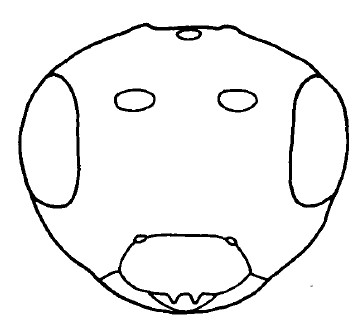
shapeHead behind eyes roundly narrowed, 1.2 times as wide as mesonotum, its width 1.6 - 1.8 times its length. Temples dorsally 1.2 - 1.3 times longer and laterally 2 times longer than eye. The base of ocellar triangle slightly longer than ocular-ocellar line (13:12, 12:10). Distance between ocelli 2 - 2.5 times ocellus diameter (fig. 2). Longitudinal diameter of eye 1.8 -1.9 times the transversal one, 1.8–2 times height of malar space. Face in upper part with longitudinal medial carina, its width 1,8 times height, 1,4 times longitudinal diameter of eye. Inter-tentorial line slightly longer than line between tentorial pit and eye. Clypeus in the middle of outer margin with two teeth which are in small specimens fine (fig. 1) [TL3] [T14]. In dorsal view temple 1.2 times eye length. Clypeus with two tooth-like processes, close together [Zh1].
sculptureHead finely and densely rugose-punctulate, dull. Vertex behind ocelli and temple slightly transversally striate. Face with thick numerous twisting rugae, inclined from its upper lateral corners like a fan. Clypeus finely punctulate, shiny [TL3].
colorPalpi dirty brown [TL3]
antenna
shape ♀Antennae slightly shorter than body, robust behind middle, very slender apically. Length of 3rd and 4th segment 4 and 3,5 times their width, respectively; other segments up to 7th or 8th gradually shorter, 9-11th or 10-12th segments 2 times longer than their width; length of the two subapical segments 3 times their width. Apical segment of antenna sometimes flattened [TL3]. Antennae slightly shorter than body, the middle part is thick and the ends are quite thin. 3rd and 4th segment 4 and 3.5 times as long as wide respectively. segment (9)10 - 11 (12) twice as long as wide [Zh1].
shape ♂
color
mesosoma
shapeMesosoma with very convex mesonotum anteriorly, with deep notauli, its length 1.3 - 1.5 times its height. Mesonotum lateroposteriorly with processes which are larger than lateral teeth of propodeum. Propodeum with distinct transverse carina and small flattened and rounded lateral teeth [TL3] [T14]. Mesosoma 1.3 times as long as high. Propodeum with a transverse carina and small teeth [Zh1].
sculptureMesosoma predominantly roughly rugose. Mesonotum with longitudinal carina in the middle, areolate-rugose in front of scutellum and along back part of notauli, upper part of propodeum areolate-rugose. Scutellum rugose-punctulate, slightly shining. Sternauli roughly crenulate, more fine in small specimens [TL3]. Mesonotum with a very obvious longitudinal groove. The middle lobe clearly higher than the lateral lobes [Zh1].
color
legs
shapeLength of hind femur 3 times width. Inner spur of hind tibia slightly shorter than 0,5 length of Ist segment of hind tarsus; 5th segment of hind tarsus longer than 3rd, but shorter than the 2nd [TL3].
sculpture
colorApex of fore and middle femora, fore and middle tibiae, tarsi and trochanters of middle and hind legs yellowish-brown. Hind tarsi dirty brown. Hind tibiae in apical half dark brown, in basal part brown, before middle slightly yellowish. Fore and middle tibiae and tarsi sometimes brown. Trochanters of all legs sometimes brownish-yellow [TL3]. Legs dark-colored, trochanters of all legs yellowish-brown, hind tibia brown, slightly lighter or yellowish in front of middle [T14].
wings
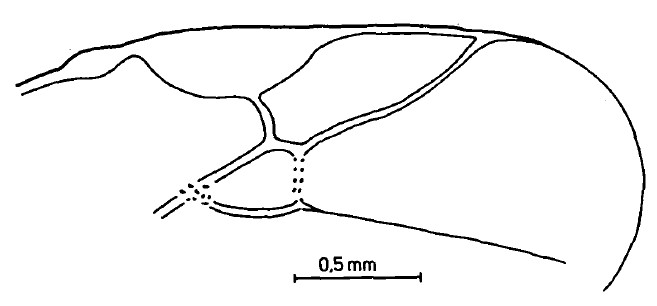
shapeMarginal cell 3 - 4 times as large as 2nd submarginal cell, 1-R1 equal to length of pterostigma; SR1 S-shaped, 2,5 times longer than 2-SR; 3-SR short, approximately 2 times shorter than r (fig. 3). 1-CU1 : cu-a = 0.6 - 0.8 [TL3]. SR1 S-shaped, 1-R1 as long as pterostigma [Zh1].
colorWings infuscate. Pterostigma and veins of wing brown, in its basal half yellowish [TL3]. Wings darkened, but lighter in the basal half, with yellowish mediocubital and basal veins [T14]. The wings are slightly smoky [Zh1].
metasoma
shapeCarapace of metasoma more narrowed anteriorly than posteriorly, apically incurved in 0,1 of its length, in basal third with two convergent posterior [?] carinae, its length 1.8-2 times width (fig. 4), 3,5 times maximum height (in apical part - fig. 5) [TL3]. The metasoma is long elliptical in dorsal view, and is more contracted towards the base. The length is 1.8-2.0 times its width [Zh1].
sculptureCarapace of metasoma in basal part with few twisting and anastomosed longitudinal rugae which gradually disappear behind its middle. Sometimes these rugae reach only the middle of metasoma. Apex of metasoma unclearly areolate-rugose [TL3].
colorMetasoma with two yellow spots baso-laterally [TL3]. The base 1/3 is yellow or has a pair of yellow spots [Zh1].
♀ ovipositorOvipositor hidden [TL3]. The ovipositor is short and hidden [Zh1].
♂ apertureAperture oval [Zh1].
other info
distributionCH [FE].
remarksThe species differs from majority of species of the genus Microchelonus in the presence of two teeth in the middle of outer margin of clypeus - similar to the genus Ascogasler. It is closely related to Microchelonus flagellaris TOBIAS, 1989 from Russian Far East, because of its small 2nd radiomedial cell very narrowed anteriorly, the structure of antennae, deep notauli and colouration. It differs from this species by teeth on clypeus, short temple, mesosoma and metasoma, and small lateral teeth of propodeum [TL3].
The closest European species is Microchelonus temporalis TOBIAS, 1986. The new species differs from it in the small 2nd radiomedial cell very narrowed anteriorly, deep notauli, convex temple, the presence of yellow spots at base of metasoma, and larger body size [TL3].
hosts
type description
Microchelonus bidentulus sp. nov.
The species differs from majority of species of the genus Microchelonus in the presence of two teeth in the middle of outer margin of clypeus - similar to the genus Ascogasler. 1t is closely related to Microchelonus flagellaris TOBIAS, 1989 from Russian Far East, because of its small 2nd radiomedial cell very narrowed anteriorly, the structure of antennae, deep notauli and colouration. It differs from this species by teeth on clypeus, short temple, mesosoma and metasoma, and small lateral teeth of propodeum.
The closest European species is Microchelonus temporalis TOBIAS, 1986. The new species differs from it in the small 2nd radiomedial cell very narrowed anteriorly, deep notauli, convex temple, the presence of yellow spots at base of metasoma, and larger body size.
Female. Body length 3,5 - 4,85 mm (holotype 4,85 mm, paratypes 3,5 - 4 mm). Head behind eyes roundly narrowed, 1,2 times width of mesonotum, its width 1,6 times length, twice medial length. Tempora dorsally 1,2 times longer and laterally 2 times longer than eye. The base of ocellar triangle slightly longer than ocular-ocellar line (13:12, 12:10). Distance between ocelli 2 - 2,5 times ocellus diameter (fig. 2). Longitudinal diameter of eye 1,8 -1,9 times the transversal one, 1,8 times height of cheek. Face in upper part with longitudinal medial carina, its width 1,8 times height, 1,4 times longitudinal diameter of eye. Inter-tentorial line slightly longer than line between tentorial pit and eye. Clypeus in the middle of outer margin with two teeth which are in small specimens fine (fig. 1). Antennae slightly shorter than body, robust behind middle, very slender apically. Length of first and second segment of flagellum 4 and 3,5 times their width, respectively; other segments up to 7th or 8th gradually shorter, 7-9th or 8-10th segments 2 times longer than their width; length of the two subapical segments 3 times their width. Apical segment of antenna sometimes flattened. Mesosoma with very convex mesonotum anteriorly, with deep notauli, its length 1,3 times height. Mesonotum lateroposteriorly with processes which are larger than lateral teeth of propodeum. Propodeum with distinct transverse carina and small flattened and rounded lateral teeth.
Radial cell of wing 3 times 2nd radiomedial cell, its anterior margin equal to length of pterostigma; 3rd abscissa of radial vein S-shaped, 2,5 times longer than Ist radio-medial vein; 2nd abscissa of radial vein short, approximately 2 times shorter than Ist one (fig. 3). Distance from nervulus to basal vein 0,6 - 0,8 nervulus length. Length of hind femur 3 times width. Inner spur of hind tibia slightly shorter than 0,5 length of Ist segment of hind tarsus; 5th segment of hind tarsus longer than 3rd, but shorter than the 2nd. Carapace of metasoma more narrowed anteriorly than posteriorly, apically incurved in 0,1 of its length, in basal third with two convergent posterior carinae, its length 1,8-2 times width (fig. 4), 3,5 times maximum height (in apical part - fig. 5). Ovipositor hidden.
Head finely and densely rugose-punctulate, dull. Vertex behind ocelli and temple slightly transversally striate. Face with thick numerous twisting rugae, inclined from its upper lateral corners like a fan. Clypeus finely punctulate, shiny. Mesosoma predominantly roughly rugose. Mesonotum with medial longitudinal carina, areolate-rugose posteriorly and along back part of notauli, upper part of propodeum areolate-rugose. Scutellum rugose-punctulate, slightly shining. Sternauli roughly crenulate, more fine in small specimens. Carapace of metasoma in basal part with few twisting and anastomosed longitudinal rugae which gradually disappear behind its middle. Sometimes these rugae reach only the middle of metasoma. Apex of metasoma unclearly areolate-rugose.
Body black. Apex of fore and middle femora, fore and middle tibiae, tarsi and trochanters of middle and hind legs yellowish-brown. Palpi and hind tarsi dirty brown. Hind tibiae in apical half dark brown, in basal part brown, before middle slightly yellowish. Fore and middle tibiae and tarsi sometimes brown. Trochanters of all legs sometimes brownish-yellow. Metasoma with two yellow spots baso-laterally. Wings infuscate. Pterostigma and veins of wing brown, in its basal half yellowish.
Holotype: ♀, Slovakia occ, Biele Karpaty Mountains, Chocholnianska dolina Valley - Gregorova, July 9, 1992, J. LUKAS Igt.
Paratypes: The same data, 2 ♀♀ 9 July 9, 1992; 3 ♀♀, July 20, 1992; 1 ♀, August 1, 1992; 3 ♀♀, July 15, 1993; J. LUKAS Igt. - 1 ♀, July 3, 1934, Nizky Jesenik Mountains, GREGOR Igt.
Holotype and part of paratypes are deposited in Zoological Institute of Comenius University in Bratislava, part of paratypes in Zoological Institute of Russian Academy of Sciences in Saint Petersburg, paratype from Nizky Jesenik Mountains in the MoravianMuseum, Brno.
Data used in the multi-access key
These data are collected from the species descriptions and redescriptions, from published figures and photographs and from own measureements and observations. For a description of the different variables and value classes see this
pdf.
| morphology |
| basic information | female | male |
| body length (mm): | (3.5) 3.5 - 4.7 (4.9) | (3.5) 3.5 - 4.7 (4.9) |
| number of antennal segments: | 16 | --- |
| head, dorsal view |
| Head width : length | narrow | narrow |
| Temples narrowing - widening | narrowing, parallel | narrowing, parallel |
| Eye length : temple length | 0.75 - 1.0 | 0.75 - 1.0 |
| Roundness temple | medium | medium |
| POL : OD | 2 - 3 | 2 - 3 |
| Ocellar triangle shape | very narrow | very narrow |
| Excavation of head | 15 - 25% | 15 - 25% |
| head, lateral view |
| Head height : length | --- | --- |
| Eye height : length | very short, short | very short, short |
| Temple length : eye length | short, long | short, long |
| head, frontal view |
| Head width : height | narrow, wide | narrow, wide |
| Face width : height | narrow | narrow |
| Eyes converging ventrally | about parallel | about parallel |
| EH : MSL | very short, short | very short, short |
| Clypeus width : height | transverse | transverse |
| Clypeus extending above bottom of eyes | far below | far below |
| Tentorial pits | small | small |
| Shape of lower margin clypeus | two teeth | two teeth |
| antennae |
| Antennal shape | clearly widened | filiform, not widened |
| Segment 3 length : width | long | --- |
| Penultimate segment length : width | long | --- |
| Length of antenna : length of body | --- | 3: long, 4: very long |
| mesosoma, lateral view |
| Length : height | short, medium | short, medium |
| transverse carina | well developed | well developed |
| lateral teeth | weak, small, short | weak, small, short |
| mesosoma, ventral view |
| Prepectal carina lamelliform | indistinct | indistinct |
| legs |
| Hind femur length : width ratio | short | short |
| Hind tibia length : hind tarsus length ratio | --- | --- |
| Hind tibia (longest) spur length : metatars length ratio | short | short |
| wings |
| Vein 1-R1 length : pterostigma length | medium, long | medium, long |
| Vein r length : vein 3-SR length | long | long |
| Shape vein SR1 (straight / concave / convex) | convex | convex |
| S-shape vein SR1 | apically convex | apically convex |
| cell M : cell Sm2 | Sm2 small | Sm2 small |
| Pterostigma length : width ratio | medium | medium |
| Angle between radial vein (r) : vein 1-R1 | medium, blunt | medium, blunt |
| metasoma, dorsal view |
| Length : width ratio of metasoma | short, medium | short, medium |
| Shape of metasoma | tapering to base | tapering to base |
| metasoma, lateral view |
| Length : height ratio of metasoma | medium, long | medium, long |
| posterior : anterior height ratio of metasoma | small | small |
| Position of maximum height | posterior | posterior |
| metasoma, ventral view |
| Metasoma posteriorly curved forwards | just/slightly incurved | just/slightly incurved |
| male apical aperture |
| Aperture width : metasoma width | no aperture | medium, large |
| Aperture shape | n. a. | oval |
| Median process shape | n. a. | --- |
| sculpture |
| head |
| general coarseness | medium, coarse | medium, coarse |
| clypeus |
| coarseness punctation | punctulate | punctulate |
| density punctation | --- | --- |
| face |
| sculpture type | rugose | rugose |
| sculpture direction | diagonal/concentric | diagonal/concentric |
| vertex and temple |
| sculpture type | striate (striolate), striate-rugulose | striate (striolate), striate-rugulose |
| mesonotum |
| sculpture type | --- | --- |
| scutellum |
| middle | rugose / striate | rugose / striate |
| lateral | rugose / striate | rugose / striate |
| metasoma |
| base - mid sculpture | longitudinally rugose / rugose-striate | longitudinally rugose / rugose-striate |
| sculpture at apex | rugose, rugulose | rugose, rugulose |
| coarse / fine boundary | base (to 50%), mid (50 - 70%) | base (to 50%), mid (50 - 70%) |
| color |
| head |
| mandibles color pattern | --- | --- |
| palpi, lightest color | brown, red | brown, red |
| antennae |
| scapus, lightest color | black, dark brown | black, dark brown |
| segment 3 and 4, lightest color | black, dark brown | black, dark brown |
| legs |
| fore coxae lightest colour | --- | --- |
| fore femur lightest colour | medium light | medium light |
| fore femur color pattern | tip light | tip light |
| hind femur lightest colour | dark | dark |
| hind femur color pattern | entirely dark | entirely dark |
| hind tibia lightest colour | medium light | medium light |
| hind tibia color pattern | narrow light ring | narrow light ring |
| hind basitarsus lightest colour | medium dark, medium light | medium dark, medium light |
| hind tarsus segment 2-3 lightest colour | medium dark, medium light | medium dark, medium light |
| wings |
| middle veins lightest colour | medium dark | medium dark |
| basal veins lightest colour | medium light, light | medium light, light |
| metasoma |
| metasoma colour pattern | color only on basal third | color only on basal third |
| metasoma lightest colour | light | light |
| metasoma base, colour pattern | 1, 2 or 4 spots, entirely colored | 1, 2 or 4 spots, entirely colored |
| metasoma base, light spots | n.a., 2 large spots | n.a., 2 large spots |
| metasoma base, light band | n.a. | n.a. |