Chelonus olgae
authorKokujev, 1895
synonymsCh. schmiedeknechti Szepligeti, 1898
body
shape♀ 7 -9 mm, ♂ 5.5- 6.3 mm [P7]. ♀ 6.5mm [T3]. ♀ 6.6mm [RM]. 6-7mm [Te1].
colorGround colour of body black [P7].
head
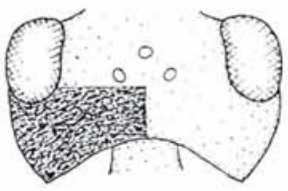
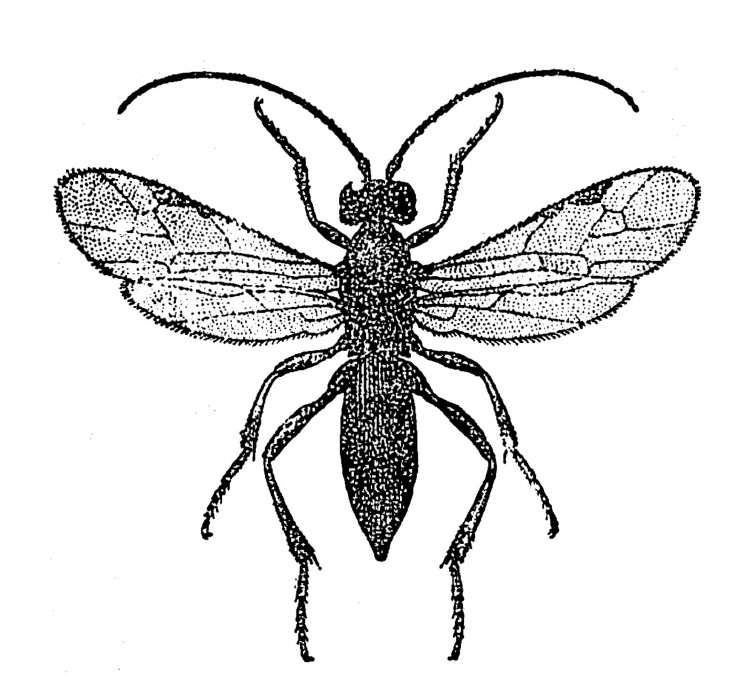
shapeThe head is a little wider than the mesosoma, with the temples a little dilated. Clypeus convex with a transverse depression before the anterior edge, which is at a blunt angle [K1]. Head in dorsal view (Fig. 2) transverse, 1.7 times as broad as long, eye somewhat longer than temple, temple moderately rounded, occiput excavated. Ocelli small and round, OOL slightly longer than POL. Eye in lateral view 1.7 times as high as wide, temple beyond eye slightly wider than eye (Fig. 3, see arrows). Malar space a bit longer than basal width of mandible. Face twice as wide as high, inner margin of eyes somewhat diverging ventrally. Clypeus twice as wide below as high medially, its lower margin medially truncate [P7].Head as wide as mesoscutum, with straight temples; width of head 1.7 times its length and 1.1 times its height. Length of temples equal to transverse diameter of eye. OOL longer than base of ocellar triangle plus [?] ocellus diameter; POL 1.5 times ocellus diameter. Longitudinal diameter of eye 1.5 times transverse one, slightly more than twice exceeding height of malar space. Width of face twice its height. Proboscis poorly developed. Length of maxillary palpi equal to height of face with clypeus [T3]. Temple shorter than eye in dorsal view, width of face twice its height [RM]. Ocelli small, OOL = 3 OD [Te1]. Clypeus separated from face by a line-shaped groove [S4, C. schmiedeknechtii]
sculptureVertex and temples roughly striated, striae parallel to the orbits of the eyes, middle of temples is shiny and indistinctly sculpted. The face is a little convex, rugulose in the middle and regularly striolated at the sides. The frontal depression is rather distinct, transversely striated, with a small smooth space near the insertion of each antenna and with a longitudinal keel, which originates between the antennae and reaches only half of the depression. Clypeus shiny, very finely punctated [K1]. ♀: Face along eye rugose, otherwise rugulose, shiny. Clypeus finely punctate, interspaces more or less longer than punctures. Frons rugose, vertex and occiput rugose to rugulose; temple finely punctate, shiny. ♂: Sculpture of head somewhat rougher [P7]. Face and vertex behind ocelli gently granulate-punctate and weakly transversely striate. Temples with strongly smoothened sculpture, lustrous [T3]. Temple with slightly smoothed sculpture (Photo 1); face transversely striate and punctate (Photo 2) [RM].
colorMandibles reddish at base, black at tip - Palpi red [K1]. ♀: Mandible dark rusty, palpi brownish greyish or light brownish yellow. ♂: palpi brown to dark brown [P7]. maxillary palps and mandibles brownish [RM].
antenna
shape ♀Antennae black, recoiled at the end [K1]. Antenna long, nearly as long as to as long as body and with 45 antennomeres. Third segment 3.3 times as long as broad apically, further segments gradually shortening and attenuating so that penultinate segment 1.4-1.6 times as long as broad [P7]. Antennae 38–44-segmented. Antennae very slender, filiform, as long as body, number of their segments over 30; length of 3rd segment 4.0 times its width, 30th segment twice as long as wide [T3]. 38-39 segments [Ay1]. Antennae 45-segmented, as long as length of body, length of the 3rd segment 4.0 times its width, apical segments of antenna twice as long as their width [RM]. 33-44 segments [Te1].
shape ♂Antenna almost as long as body and with 41-44 antennomeres [P7]. Antenna as long as body, setaeceous, 39-45 segments. Basal segments 3-4 times as long as wide [Te1].
color♀: Antenna black with more or less rusty to dark rusty tint. ♂: Antenna black [P7]. ♀ antennae black [T3].
mesosoma
shapeMesonotum almost vertically truncated anteriorly. Propodeum posteriorly almost vertically truncate; the transverse carina is sharp, arched and terminated on each side by a tooth; [K1]. Mesosoma in lateral view 1.6 times as long as high. Transverse carina of propodeum distinct and laterally ending in a small tubercule. [P7]. Length of mesosoma 1.35 times its height. Propodeum with fine transverse carina and small rounded lateral teeth [T3].
sculptureMesonotum very finely rugulose: the notauli are indicated only by the irregular rows of points, sometimes confluent; other confluent points can be seen near the wing insertions. Mesopleurae rather coarsely, not densely punctuated. Mesosternum finely dotted, the larger points near the middle coxae and along the middle [K1]. Scutellum shiny and smooth, covered laterally and towards the tip with very fine longitudinal rugae. The propodeum is is roughly reticulated, without keels [K1]. Mesosoma punctate to confluent punctate, mesoscutum either almost smooth and shiny or laterally finely punctate to uneven, subshiny - Notauli distinct by somewhat roughened sculpture. Scutellum smooth and shiny. Propodeum areolate-rugose [P7]. Mesonotum punctate, with smoothened intervals between punctures; anterior part of mesoscutum weakly and sparsely punctate; punctures much coarser in posterior part, forming there longitudinal rows in places. Scutellum weakly punctate, nearly smooth. Mesopleura more coarsely punctate, with large deepened punctures. Propodeum densely rugose-punctate [T3]. Mesonotum punctate, weakly in anterior part and coarsely in posterior part (Photo 3) [RM].
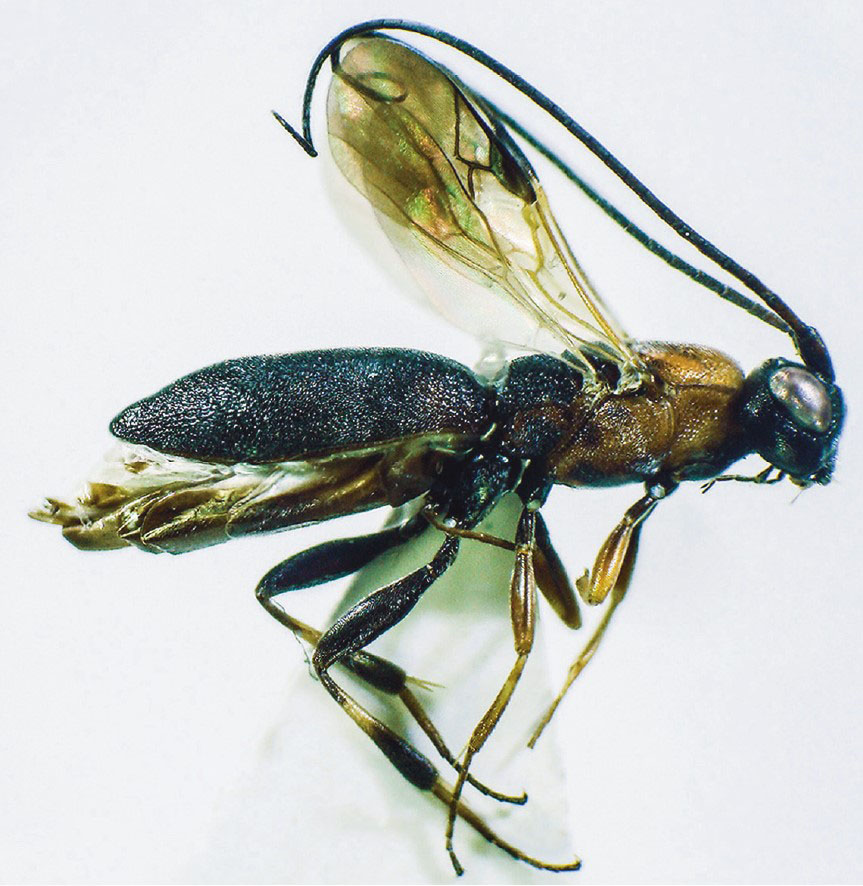
colorMesosoma entirely yellow-brown, scutellum somewhat dark in the middle [K1]. Mesosoma either almost entirely or partly reddish yellow [P7]. Mesosoma reddish yellow [T3]. Mesosoma reddish (except propodeum), scutellum dark brownish [RM]
legs
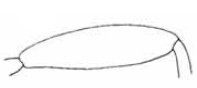
shape♀: Hind femur 3.3-3.8 times as long as broad medially (Fig. 4). Inner spur of hind tibia half as long as basitarsus. Hind basitarsus as long as tarsomeres 2 - 4 + half of fifth tarsomere combined. ♂: Hind femur 3.1-3.6 times as long as broad medially (Fig. 9) [P7]. Length of hind femur 4.3 times its width. Hind tibia slightly longer than hind tarsus, its inner spur half as long as 1st segment of hind tarsus. 5th segment of hind tarsus as long as 3rd one [T3].
sculpture
colorLegs black, with varying yellowish-red coloration: Black coxae, fore trochanters brownish, mid and hind trochanters black; fore femora yellowish red, darkened towards the base, hind femora completely black, mid femora red at the tip; the fore and mid entirely yellowish red, the hind tibiae brownish, black on the apical half, with a whitish ring before the base; tarsi reddish, blackened towards the tip, fore tarsi paler [K1]. ♀: Legs blackish brown to brown, femora 1-2 apically reddish yellow; tibiae + tarsi 1-2 light brownish yellow, tarsomeres with brownish suffusion; proximal ring of hind tibia and hind basitarsus almost entirely pale yellow, hind tibia distally blackish. ♂: Dark (i.e. black to dark brown) colour of legs more extended [P7]. Legs mostly dark; hind femur nearly black, hind tibia with yellowish median band [T3]. Hind leg black, hind tibia with a median pale band [RM].
wings
shapeVein r almost twice as short as 3-SR and forms with the latter a straight line. SR1 distinctly arched. r-m is much longer than r, and a little shorter than 3-SR. The 2nd submarginal cell is quite short and wide. The radial vein of the hind wings is strongly curved near the middle [K1]. Fore wing short, 0.6-0.7 times as long as body. Pterostigma (Fig. 5) 2.8 times as long as wide, issuing r distally from its middle; 3-SR twice to almost twice as long as r, 1-R1 one-fourth to a bit shorter than pterostigma [P7]. Marginal cell of fore wing 1.5 times as large as 2nd submarginal cell, 1-R1 nearly as long as pterostigma; 3-SR 0.7 times as long as r[?], 0.42 times as long as SR1, and 0.83 times as long as 2SR; SR1 bends towards radial cell [T3]. 1-R1 slightly shorter than pterostigma (Photo 4) [RM]. 1-R1 equal to pterostigma length [Te1].
colorTegulae red. Wings slightly smoky, with a colorless line below the pterostigma and two similar ones, one on the vein r-m, the other in the marginal cell; parastigma and veins in basal region yellowish, midline veins and stigma dark brown [K1]. Wings subfumous, pterostigma dark brown to brown, parastigma yellow, veins proximo-distally yellow to brownish yellow [P7]. Wings infuscate, basal half with pale yellowish veins [RM]. Wings light, tegulae brown, basal veins yellow [Te1].
metasoma
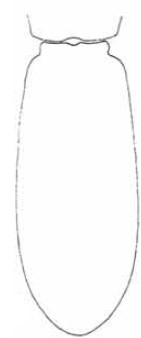
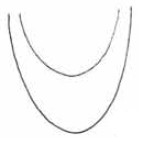
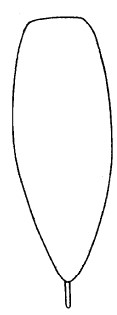
shapeMetasoma elongated, longer than the head with the mesosoma, obliquely truncated at the base, very slightly widened towards the middle and then considerably narrowed towards the extremity where it is rounded and almost half as wide as at the base. The metasoma is somewhat convex, with traces of the two sutures. Two weak basal carinae. The apex of the metasoma is separated by a deep transverse depression and its surface is almost at the level of half the height of the metasoma (fig. 1a). The ♀ ventral segments are compressed into a keel and protrude beyond the metasoma (Fig. 1b). [K1]. ♀: Carapace in dorsal view (Fig. 6) 2.7 times as long as broad anteriorly, here carapace weakly broadening, posterior half of carapace narrowing and apically pointed. Pair of basal keels indistinct. Carapace in lateral view (Fig. 7) 3.3 - 3.7 times as long as high behind, apically not incurved (Fig. 8), i.e. aparture of carapace as long as carapace itself. ♂: Carapace in dorsal view (Fig. 10) 2.2 - 2.4 times as long as broad behind, just broadening posteriorly, apically rounded. Carapace in lateral view (Fig. 11) 2.8 - 3.1 times as long as high behind, apically incurved (Fig. 12) [P7]. Metasoma narrowed towards apex approximately from anterior third (fig 13), its apex with ledge separated by transverse furrow. Length of metasomal carapace 4.0 times its height (maximum in posterior third), 2.6 times its width (maximum in anterior third); posterior part of carapace with transverse deepened furrow. Apical sternites slightly projecting from under carapace [T3]. Metasomal distinctly narrowed apically (photo 5); length of metasoma 2.5 times its maximum width in anterior third, apical sternites slightly projecting from under carapace (photo 6) [RM]. Metasoma longer than head and mesosoma together, sharply narrowed toward apex [Ay1].
sculptureBase of metasoma longitudinally rugose and reticulate. The sculpture becomes weaker and less distinct towards the end. The apex, separated by the depression, is almost smooth and shiny [K1]. Anterior third of carapace longitudinally rugose with striate elements, posterior two-thirds of carapace densely rugose to rugulose (Fig. 6) [P7]. Metasoma densely and rather coarsely punctate, with longitudinal rugae in basal half [T3]. Metasoma densely and rather coarsely punctate, with longitudinal rugae in basal half (photo 5) [RM].
colorBlack, two small yellow-brown spots at the base [K1]. Metasoma brown, with pair of yellow basal spots [T3]. Metasoma black with two indistinct brownish spots [RM].
♀ ovipositorOvipositor sheath short [P7]. Ovipositor straight [S4, schmiedeknechtii]
♂ aperture
other info
distributionDE [FE].
remarks
hosts